A 12-bit converter,
seven decades of current.
In development
Twelve bits is about four thousand counts, roughly three and a half decades. The rest of the range comes from somewhere else.
The shunt ladder does the ranging, not the converter
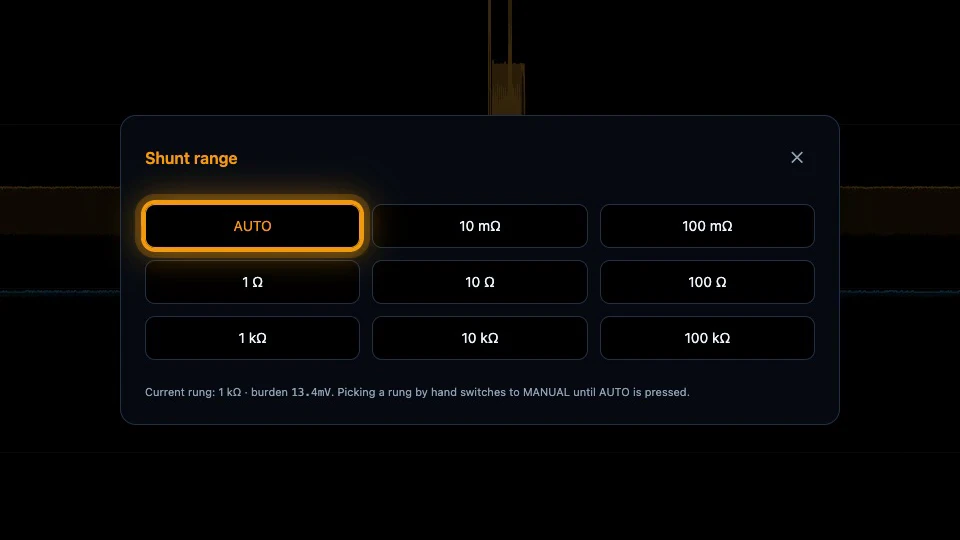
Eight shunt resistors sit in series, each behind its own switch, stepping by decades from ten milliohms to a hundred kilohms. Selecting a rung changes what full scale means before the conversion happens, so the converter spends all twelve bits on the current that is actually present.
A converter with more bits buys resolution once. A ladder buys it on every reading.
Ranging happens in hardware, on every conversion
An analog watchdog inside the converter checks each conversion against the window of the rung in force. The first sample that leaves its window raises an interrupt, and the hub moves one rung or several in that one step. There are hundreds of nanoseconds between samples, so no software loop could keep up. Nothing runs between hops.
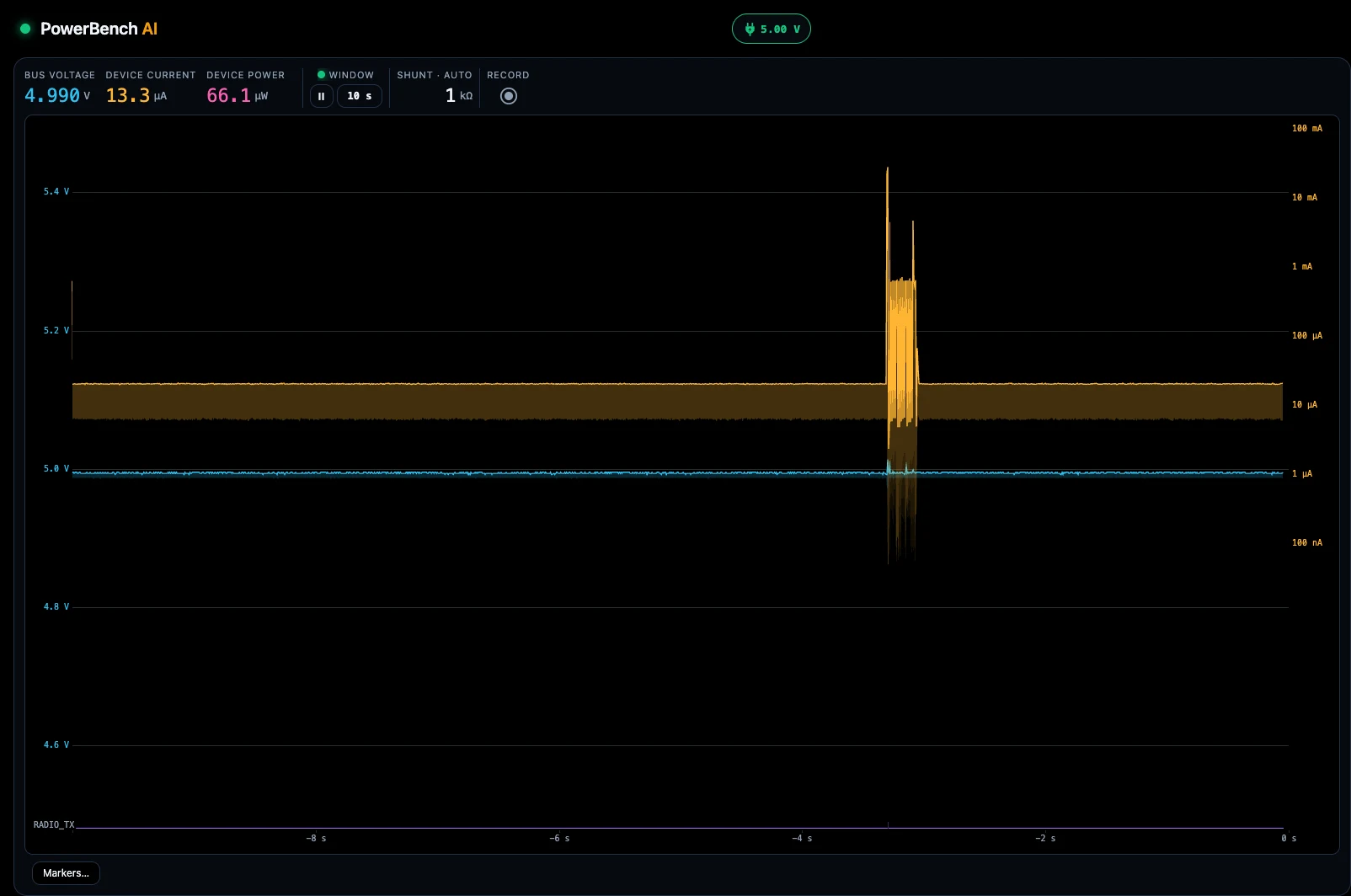
Every sample carries the rung it was converted on. The app therefore knows exactly which samples belong to a range change, and draws the current at your device's terminals straight through it.
Two rates, because they answer different questions
Current and voltage are converted at the same instant by two dedicated converters, never multiplexed, paced by a timer.
Recording folds a whole number of samples into one entry (one sample at the top rate, 2 Msps) holding the minimum and maximum of both channels. A peak between stored points is preserved rather than averaged away, and every recording rate divides the sampling rate exactly, so a recording holds its alignment over hours.
The capture processor never yields
A dedicated processor running no operating system owns every sample. It drives the converters, services the ranging interrupt, packages the stream and sends it over USB. The marker inputs ride in the same packets as the samples, so a marker and the current it labels cannot drift apart.
Your computer pauses for milliseconds at a time, and one ordinary pause is thousands of conversions. So the hub holds the stream in its own buffer through the pause, and the app drains it when your computer comes back. That split is what makes an hours-long lossless recording possible.
Specifications are on the product page, and what an agent does with the result is on the developers page.
In development. We will email you when it ships.